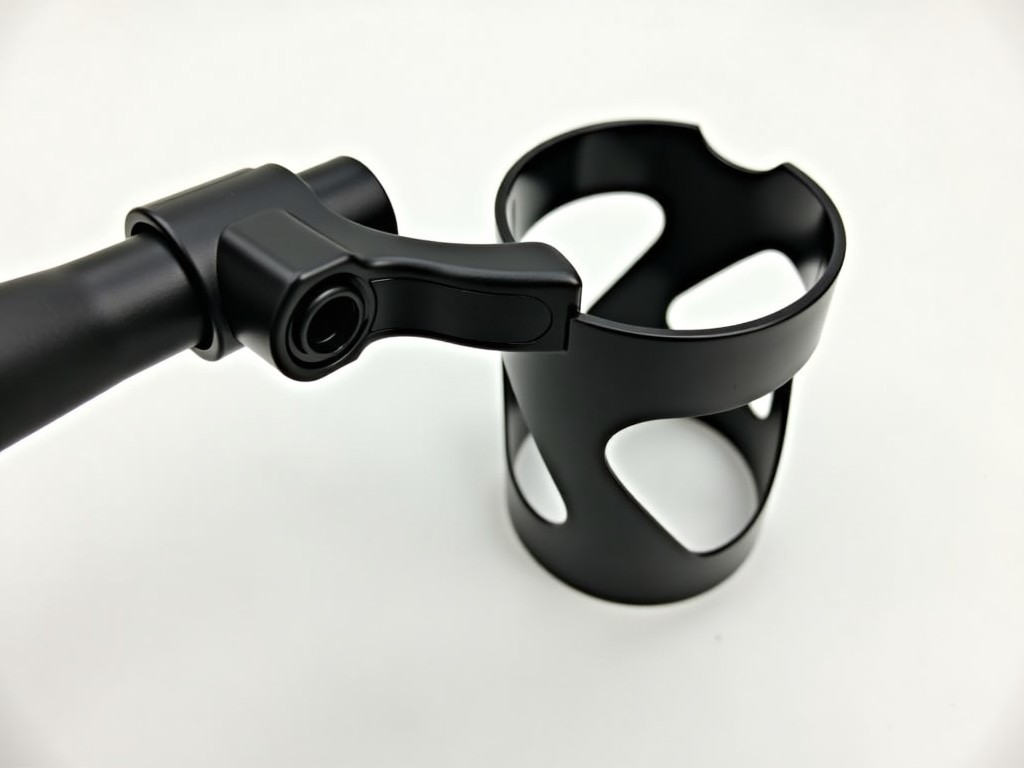
Custom Handlebar Bicycle Cup Holder Manufacturer
Custom Handlebar Bicycle Cup Holder Manufacturer
A handlebar‑mounted cup holder provides a fixed point for bottles or cans while keeping the rider’s hands on the grips. The unit clamps to the handlebar tube and features a pivoting cradle that can
- Categories:Bicycle Cup Holder
Custom Handlebar Bicycle Cup Holder Manufacturer
A handlebar‑mounted cup holder provides a fixed point for bottles or cans while keeping the rider’s hands on the grips. The unit clamps to the handlebar tube and features a pivoting cradle that can be set to a specific angle relative to the bike’s fore‑aft axis, ensuring the container remains upright under normal riding vibrations.
Key Design Parameters
- Clamping range: 22.2 mm – 31.8 mm handlebar outer diameter, with interchangeable inserts.
- Adjustable tilt: 0° – 30° upward or downward from horizontal, locked by a stainless‑steel set screw.
- Load rating: tested to hold 1.5 kg static load without slippage.
- Vibration damping: integrated elastomeric insert reduces transmitted vibration to < 0.2 g at 20 Hz.
- Overall envelope: 80 mm × 55 mm × 45 mm (L × W × H) when mounted.
Material Options
| Material | Density (g/cm³) | Tensile Strength (MPa) | Corrosion Resistance |
|---|---|---|---|
| Aluminum 6061‑T6 | 2.70 | 310 | Good (anodized) |
| Stainless Steel 304 | 8.00 | 520 | Excellent |
| Reinforced Polyamide (GF30) | 1.38 | 120 | Very good (UV stabilized) |
Customization Workflow
The process begins with a technical brief that specifies handlebar diameter, desired tilt range, load expectations, and any branding or colour requirements. Our engineering team creates a parametric CAD model that allows rapid iteration of clamp geometry and cradle shape. After client approval, a prototype is machined or molded and subjected to functional testing. Tooling is then prepared for the selected material, and production runs are scheduled according to the agreed lot size.
Throughout the workflow we maintain traceability: each lot receives a unique batch number, and critical dimensions are logged in a CMM report. Changes to the design after tooling require a formal engineering change notice, ensuring that any deviation is evaluated for impact on load capacity and vibration performance.
Typical Applications in the Cycling Sector
Commuter and city bikes benefit from a handlebar cup holder because riders often need to carry water or coffee while navigating traffic, and removing a hand from the bar increases risk. The holder’s low profile does not interfere with brake levers or shifters, and its adjustable angle accommodates both upright and slightly forward riding positions.
Electric assist bikes frequently carry larger batteries that shift the centre of mass rearward; a front‑mounted holder helps balance the load distribution, improving handling at low speeds. Cargo bikes used for urban deliveries employ the holder to keep beverages accessible during stops, reducing the need to dismount.
On mountain‑bike handlebars, the damping insert minimizes spillage caused by rough terrain, while the quick‑release clamp allows removal for transport or storage.
Quality Assurance & Testing
Dimensional conformity is verified on a coordinate measuring machine with a tolerance of ±0.05 mm on clamp bore and cradle pivot holes. Torque retention is measured by applying a 10 Nm cyclic load to the clamp bolt for 5000 cycles; any rotation beyond 0.5° triggers rejection.
Fatigue testing simulates 100 000 road‑vibration cycles at 2 g acceleration; the holder must show no crack initiation or permanent deformation. Corrosion resistance is assessed via a 48‑hour salt‑spray test per ASTM B117, with visual inspection for white rust or pitting.
All test results are archived and made available to the customer upon request, providing documented evidence of conformance to the agreed specification.
Lead Times, Packaging & Shipping
Standard production lead time is 4–6 weeks after receipt of approved tooling and material confirmation, depending on order complexity and current shop load. For expedited runs, a 2‑week schedule can be arranged with applicable surcharges.
Finished units are packed in single‑wall corrugated boxes with die‑cut foam inserts that immobilize each holder. Aluminum and stainless steel parts are wrapped in VCI‑treated anti‑static tape to prevent surface oxidation during transit. Each box carries a label showing part number, batch code, and quantity.
For international shipments, pallets are secured with stretch film and corner boards, and a fumigation‑free ISPM‑15 compliant pallet is used when required by destination regulations.
Frequently Asked Questions
- Can the clamp diameter be customized? Yes, we can machine inserts for non‑standard handlebar sizes ranging from 20 mm to 35 mm.
- What information is needed for a quotation? Required details include handlebar OD, desired tilt angle range, load capacity, material preference, surface finish (e.g., anodized, powder‑coated), and any logo or branding specifications.
- Which materials are available for the cradle? Options are aluminum 6061‑T6, stainless steel 304, and glass‑filled polyamide; each can be supplied with different surface treatments.
- How is quality inspected? Every lot undergoes CMM dimensional checks, torque‑retention cycling, vibration fatigue, and salt‑spray corrosion testing as described above.
- What packaging options are offered? Standard is a foam‑inserted corrugated box; we also provide reusable plastic trays for high‑volume orders and custom‑printed retail packaging upon request.
- How are export shipments protected? Parts are wrapped in VCI anti‑static film, placed in sealed cartons, and stacked on ISPM‑15 compliant pallets with stretch‑film stabilization.
- What is the typical production lead time? Four to six weeks for standard tooling; two weeks for express service with applicable fees.
- How can samples be arranged? We can ship a functional prototype (usually machined from the selected material) within 5‑7 business days after design approval; sample costs are credited against the first production order.
Get a Quote
To discuss your specific handlebar cup holder requirements, please provide the technical details outlined above. Our engineering team will review the specifications and return a detailed quotation with lead time and tooling information.
Request a QuoteA handlebar‑mounted cup holder provides a fixed point for bottles or cans while keeping the rider’s hands on the grips. The unit clamps to the handlebar tube and features a pivoting cradle that can
Send Inquiry
If you are interested in our products, leave your information here and we will be in touch shortly.