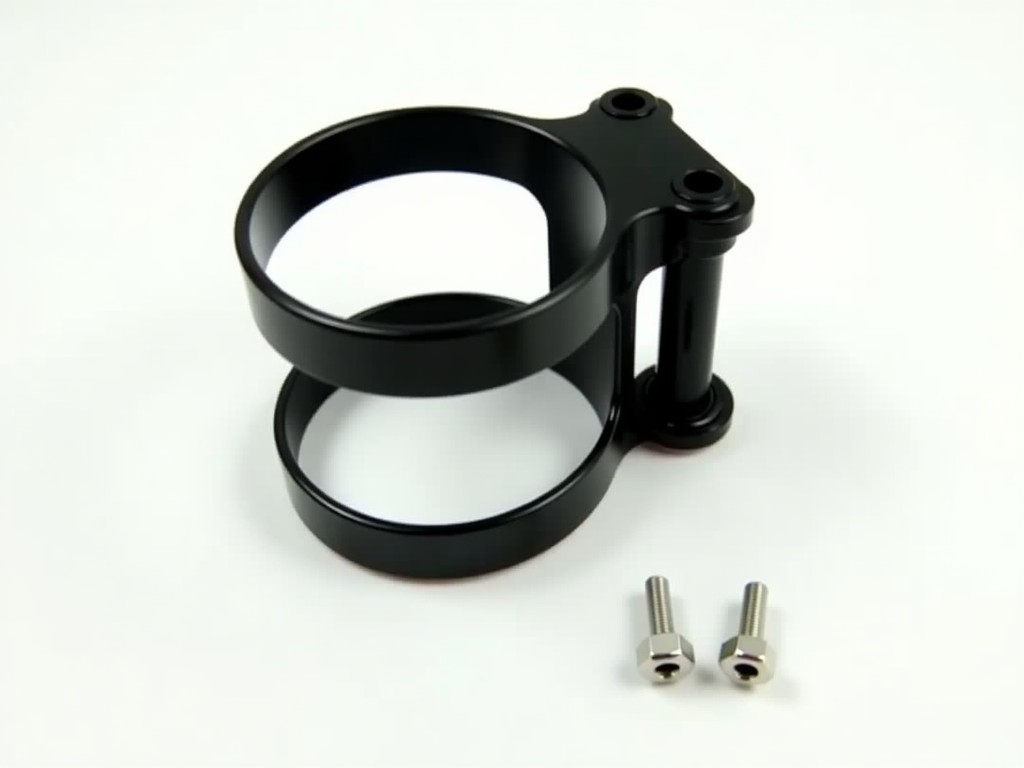
Discount Anti Slip Clamp Bicycle Cup Holder Made In China
Discount Anti Slip Clamp Bicycle Cup Holder Made In China
This device holds a beverage container onto a bicycle frame by means of a cam‑actuated clamp that presses a silicone‑lined insert against the cup wall, providing resistance to lateral slip under
- Categories:Bicycle Cup Holder
Discount Anti-slip Clamp Bicycle Cup Holder
This device holds a beverage container onto a bicycle frame by means of a cam‑actuated clamp that presses a silicone‑lined insert against the cup wall, providing resistance to lateral slip under vibration.
Design Overview
The main body is a single‑piece stamped steel U‑channel that forms the clamp jaws. A torsion spring integrated into the jaw pivot supplies the closing force. The inner surface of each jaw carries a replaceable thermoplastic elastomer (TPE) pad with a raised rib pattern to increase friction.
Actuation is achieved by pulling a cable‑style release lever; when released, the spring returns the jaws to the closed position. The lever travel is limited to 12 mm to prevent over‑extension and to keep actuation force below 30 N for single‑hand operation.
Material Selection
Clamp jaws are fabricated from cold‑rolled SPCC steel with a tensile strength of 340 MPa and a yield strength of 250 MPa, providing sufficient stiffness to resist deformation under dynamic loads.
The TPE pad is a 60 shore‑A thermoplastic vulcanizate, offering a coefficient of friction between 0.35 and 0.45 against typical polyethylene or polypropylene cup surfaces, while maintaining flexibility down to -20 °C.
The release lever and pivot pin are made from stainless steel A2 (SS304) to resist corrosion from sweat and environmental exposure.
Performance Characteristics
| Parameter | Typical Value | Unit |
|---|---|---|
| Clamp opening range | 50–80 | mm |
| Maximum static load | 150 | N |
| Coefficient of friction (cup insert) | 0.35–0.45 | – |
| Operating temperature range | -20 to +80 | °C |
| Clamp closing force (spring) | 45–55 | N |
| Lever actuation force | 20–30 | N |
Typical Applications
The holder is intended for use on bicycles where riders require a secure, removable beverage container without compromising frame geometry or adding significant weight. Its low profile allows installation on the down tube, seat tube, or handlebar clamp area.
- Road racing bikes – minimal aerodynamic impact due to compact form factor.
- Mountain bikes – resistant to mud and shock loads thanks to corrosion‑resistant lever and spring.
- Commuter and e‑bike platforms – accommodates larger insulated cups up to 80 mm diameter.
- Cycling trainers and stationary setups – provides a stable hydration point during indoor sessions.
Quality Assurance Approach
Each batch undergoes incoming inspection of steel thickness (±0.05 mm) and hardness (HRB 55‑65). The TPE pads are checked for durometer and dimensional conformity using a calibrated Shore A gauge.
Functional testing includes a 10 000‑cycle actuation test at 2 Hz to verify spring fatigue life, followed by a slip test where a 1.5 kg load is applied laterally while the clamp is subjected to 5 g vibration; the holder must retain the cup without movement.
Final visual inspection verifies absence of burrs, proper lever alignment, and correct pad seating. All results are recorded against the internal test specification TS‑CU‑001.
Customization Options
Design parameters can be adjusted to suit specific mounting constraints or cup geometries without altering the core mechanism.
- Clamp jaw width – adjustable from 30 mm to 50 mm to accommodate different tube diameters.
- Spring rate – selectable between 30 N/mm and 55 N/mm to tune closing force for lighter or heavier cups.
- Pad material – alternative TPU grades with hardness ranging from 50 shore‑A to 70 shore‑A for specialized surface compatibility.
- Finish – zinc‑nickel plating or black oxide coating for enhanced corrosion resistance in saline environments.
- Branding – laser‑etched logo on the lever arm or pad holder, limited to 15 mm × 5 mm area.
Frequently Asked Questions
- Can the clamp opening range be modified for non‑standard cup sizes?
- Yes, the jaw geometry can be redesigned to provide a minimum opening of 40 mm or a maximum of 100 mm, subject to a tooling review.
- What information is required to obtain a quotation?
- Provide the desired clamp width, spring rate, pad hardness, finish type, and annual volume estimate. A simple sketch or CAD file of the mounting interface helps speed up the quote.
- How are production lead times handled?
- Standard lead time is 4‑6 weeks after receipt of approved drawings and payment of tooling fees, assuming material availability.
- Are samples available for evaluation?
- Sample units can be shipped upon request; the customer covers sample and freight costs, and the sample cost is credited against the first production order.
For further technical details or to request a formal quotation, please contact our sales team.
This device holds a beverage container onto a bicycle frame by means of a cam‑actuated clamp that presses a silicone‑lined insert against the cup wall, providing resistance to lateral slip under
Send Inquiry
If you are interested in our products, leave your information here and we will be in touch shortly.