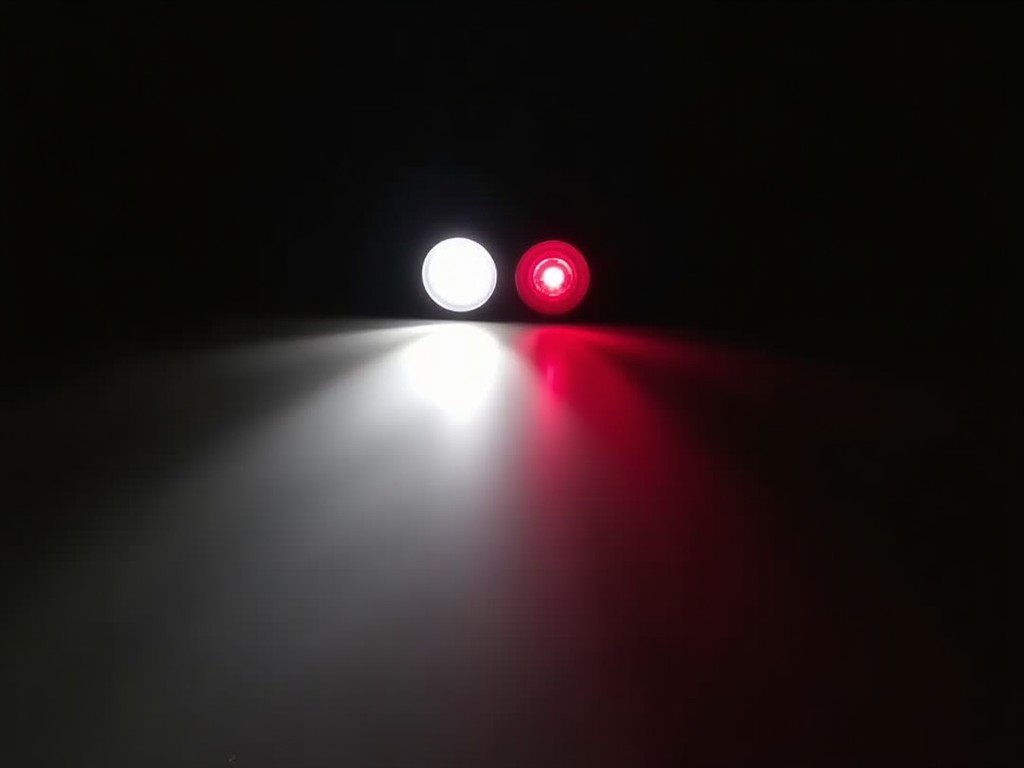
Custom Waterproof Led Bicycle Front Light Manufacturer
Custom Waterproof Led Bicycle Front Light Manufacturer
The front light is designed for mounting on bicycle handlebars and provides a focused beam for night riding and low‑visibility conditions. Its housing is machined from aluminum alloy to dissipate
- Categories:Bicycle Front Light
Custom Waterproof LED Bicycle Front Light Manufacturer
The front light is designed for mounting on bicycle handlebars and provides a focused beam for night riding and low‑visibility conditions. Its housing is machined from aluminum alloy to dissipate heat generated by the LED array.
Peak luminous intensity is specified in candela and measured at the optical axis. Typical values range from 200 cd to 800 cd depending on LED selection and drive current. Beam angle is defined by the reflector geometry and commonly falls between 10° and 20° for a spot pattern suitable for forward illumination.
Operating voltage is determined by the battery system or dynamo output and usually lies between 6 V and 12 V DC. Current draw is regulated by a constant‑current driver to maintain stable light output across the voltage range. Power consumption at full brightness typically falls between 1 W and 3 W, enabling extended run‑time on a 2000 mAh lithium pack.
The housing consists of two halves that are sealed with an O‑ring groove and fastened by stainless‑steel screws. Heat‑sink fins are integrated into the rear housing to increase surface area for passive cooling. Weight of the assembled unit, including bracket, is kept under 45 g to minimize impact on bike handling.
Ingress protection is achieved through a combination of gasket compression and potting of the electronic assembly. The product meets IP67, meaning it can withstand temporary immersion to 1 m depth for 30 minutes without water ingress. Salt‑spray testing is performed on a sample batch to verify corrosion resistance of the metal parts.
Customization is available for optical, electrical, and mechanical parameters to suit OEM requirements.
- LED color temperature (e.g., 5000K, 6500K) or RGB options
- Drive current settings to adjust brightness and power consumption
- Lens material (polycarbonate vs. glass) and coating for UV resistance
- Bracket design (clamp diameter, quick‑release, integrated stem mount)
- Cable length and connector type (JST, Molex, bare wires)
- Laser‑etched logo or part number on the housing
The light is suited for urban commuting, trail riding, and cargo bicycles where reliable illumination improves safety. Because the beam pattern can be narrowed or widened, the same base design serves both high‑speed road use and low‑speed off‑road navigation. OEMs often integrate the unit into custom handlebar stems or frame‑mounted brackets to achieve a clean aesthetic.
Each unit undergoes a functional test that measures luminous flux, forward voltage, and seal integrity. Statistical process control is applied to the LED binning and driver tolerance to ensure lot‑to‑lot consistency. Final inspection includes a 2‑hour cycle of temperature shock (−20 °C to +60 °C) followed by a re‑check of IP67 sealing.
| Parameter | Typical Value | Customizable Range |
|---|---|---|
| Luminous intensity (cd) | 200–800 | 100–1200 (upon request) |
| Beam angle (°) | 15 | 10–30 (adjustable reflector) |
| Operating voltage (V) | 9 | 6–16 (depends on battery/dynamo) |
| Power consumption (W) | 2 | 0.5–5 (drive current selectable) |
| Weight (g) | 38 | 30–50 (alternative materials) |
| IP rating | IP67 | IP66/IP68 (optional sealing) |
| Housing material | Aluminum alloy 6061 | Plastic composite, stainless steel (upon request) |
FAQ
Common questions from procurement engineers are addressed below.
- Can the LED color temperature be customized? Yes, the LED bin can be selected from 4000K to 7000K, and custom wavelengths are available upon request.
- What information is required before quotation? Required details include desired luminous intensity, operating voltage, mounting interface, quantity, and any special environmental certifications.
- How is quality inspected? Each lot undergoes 100% functional testing, AQL visual inspection, and accelerated aging tests per IEC 62262.
- What packaging methods are available? Standard packaging is anti‑static bags inside corrugated cartons; foam inserts or reusable trays can be arranged for delicate surfaces.
The front light is designed for mounting on bicycle handlebars and provides a focused beam for night riding and low‑visibility conditions. Its housing is machined from aluminum alloy to dissipate
Send Inquiry
If you are interested in our products, leave your information here and we will be in touch shortly.