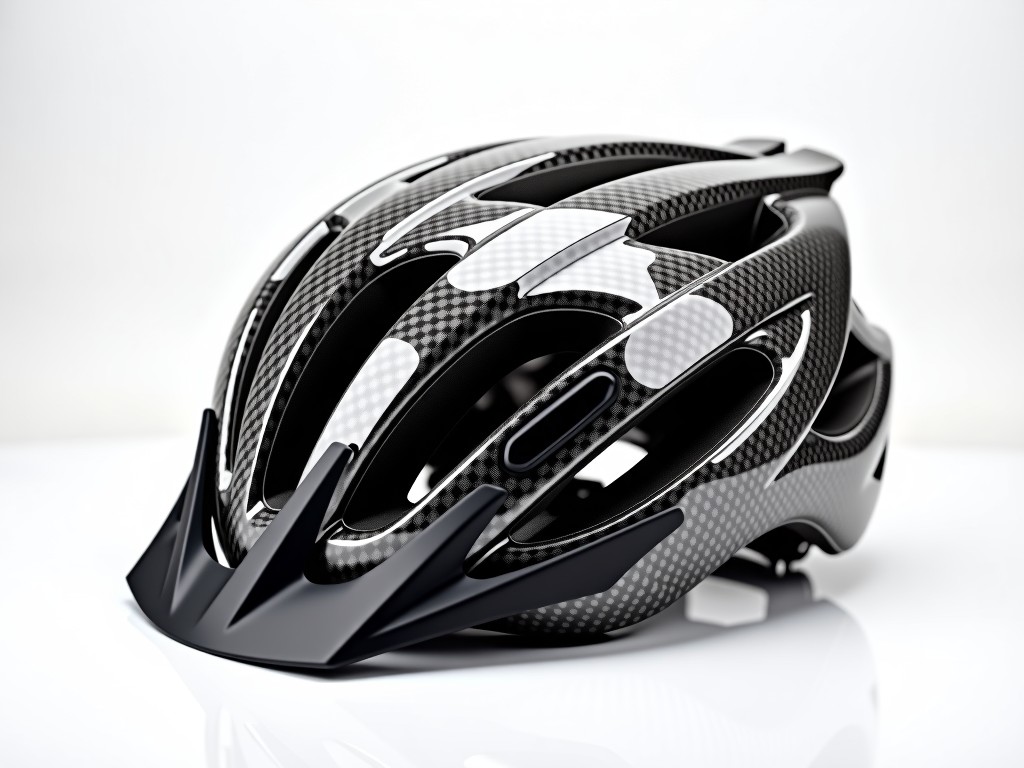
Custom Carbon Fiber Texture Bicycle Safety Helmet Producer
Custom Carbon Fiber Texture Bicycle Safety Helmet Producer
This product page outlines the engineering basis for helmets that combine a carbon‑fiber reinforced polymer shell with a textured surface finish, tailored to the specifications of bicycle‑safety OEMs
- Categories:Bicycle Safety Helmet
Custom Carbon Fiber Texture Bicycle Safety Helmets
This product page outlines the engineering basis for helmets that combine a carbon‑fiber reinforced polymer shell with a textured surface finish, tailored to the specifications of bicycle‑safety OEMs and distributors. The focus is on measurable design attributes that influence impact performance, weight, and manufacturability.
Material Composition and Structural Design
The outer shell utilizes a unidirectional carbon‑fiber prepreg impregnated with an epoxy matrix, cured to achieve a tensile modulus of approximately 230 GPa and a density of 1.55 g/cm³. A thin overlay of a pigmented clear coat creates the reproducible “carbon fiber texture” while protecting the fibers from UV degradation. Internal energy‑absorbing liners are typically expanded polystyrene (EPS) with a density range of 20‑30 kg/m³, selected to meet the force‑time criteria of EN 1078.
- Shell thickness: 1.2 mm ± 0.1 mm, calibrated via laser micrometry.
- Fiber volume fraction: 55 % ± 3 %, determined by acid digestion test.
- Surface roughness (Ra): 1.8 µm ± 0.3 µm, measured with a contact profilometer.
- Impact absorption: peak deceleration ≤ 250 g in drop‑test rig per EN 1078 annex A.
Customization Capabilities
Geometry adjustments are accommodated through CNC‑milled foam cores that can be altered in vent placement, occipital wrap, and forehead contour without changing shell thickness. Surface finish options include matte, satin, or a gloss level defined by a 60‑specular gloss unit range, all achievable via adjustable spray‑gun parameters. Color matching is performed using spectrophotometric data supplied by the client, with a ΔE < 2 tolerance.
Additional functional inserts such as MIPS‑compatible low‑friction layers, reflective tape strips, or integrated mounting brackets for lights can be co‑molded or adhered post‑cure, with bond strength verified by ASTM D903 peel testing (> 1.5 N/mm).
Performance and Safety Certification
Helmets are subjected to the full EN 1078 test suite: impact attenuation at 0.5 m, 1.0 m, and 1.5 m drop heights, retention system strength (≥ 50 N), and peripheral vision field (≥ 105° horizontally). Test reports include peak acceleration, duration, and energy absorbed, allowing direct comparison to baseline EPS‑only designs. Compliance documentation is issued per batch, with traceability to the specific prepreg lot number.
Optional certification to CPSC 1203 or AS/NZS 2063 can be arranged, requiring additional impact‑velocity conditioning and label verification. All test fixtures are calibrated quarterly against NIST‑traceable standards.
Manufacturing Process Overview
Prepreg sheets are laid up on a CNC‑machined aluminum mold using vacuum‑bagging to achieve a void content below 1.5 %. Cure cycles follow a ramp‑hold profile: 25 °C → 120 °C at 2 °C/min, hold 120 °C for 60 min, then cool to ambient under pressure. Post‑cure machining removes flash and creates vent holes with a tolerance of ±0.2 mm.
Liner insertion occurs after shell demolding; EPS beads are expanded in‑place via steam molding to fill the internal cavity precisely. Final surface coating is applied in a controlled‑humidity spray booth, with film thickness measured by dry‑film DFT gauge (target 25 µm ± 5 µm).
Quality Control and Inspection
Each helmet undergoes non‑destructive ultrasonic C‑scan to detect delamination or fiber wrinkling, with acceptance criteria set at < 0.5 mm² defect area per square decimeter. Dimensional checks are performed on a coordinate‑measuring machine (CMM) for critical interfaces: strap anchors, visor mount, and occipital lock.
Impact test samples are pulled from every 500‑unit lot; statistical process control (SPS) charts track peak acceleration trends, triggering a lot hold if the moving average exceeds three sigma from the mean. Visual inspection for surface texture uniformity is conducted under 45° lighting with a calibrated gloss meter.
Typical Applications
Road‑racing teams benefit from the reduced frontal area and consistent vent geometry that aids aerodynamic cooling at speeds exceeding 45 km/h. Urban commuter models emphasize the reflective tape integration and low‑profile shape to improve visibility in mixed‑traffic environments without compromising the required impact envelope.
Mountain‑bike variants often request increased occipital coverage and a reinforced rim to resist branch‑impact scenarios, which is achieved by adjusting the foam core thickness in the rear shell while maintaining the same carbon‑fiber layup schedule.
Specification Table
| Parameter | Typical Value / Customizable Range |
|---|---|
| Shell Material | Carbon‑fiber/epoxy prepreg (UD + woven texture) |
| Nominal Shell Thickness | 1.2 mm ± 0.1 mm (adjustable 0.9‑1.5 mm) |
| Fiber Volume Fraction | 55 % ± 3 % |
| Liner Type | Expanded polystyrene (EPS), density 20‑30 kg/m³ |
| Impact Performance (EN 1078) | Peak ≤ 250 g at 1.5 m drop |
| Weight (Medium Size) | 260 g ± 15 g (depending on vents & inserts) |
| Surface Finish Options | Matte, satin, gloss (60 ± 10 GU) |
| Customizable Features | Vent pattern, occipital wrap, reflective tape, MIPS layer, mounting brackets |
Frequently Asked Questions
A: Yes. The EPS liner mold is scalable; we provide size‑specific foam blocks that maintain the same shell curvature, allowing sizes from 48 cm to 64 cm circumference without redesigning the carbon‑fiber layup.
A: We need the desired shell thickness, vent layout, liner density, surface finish specifications, order quantity, and any required certifications. With these details we can deliver a formal quote within two business days and a prototype lead time of 3‑4 weeks.
Contact for Technical Inquiry
For detailed data sheets, test reports, or to arrange a sample shipment, please reach out to our engineering team via the contact form.
This product page outlines the engineering basis for helmets that combine a carbon‑fiber reinforced polymer shell with a textured surface finish, tailored to the specifications of bicycle‑safety OEMs
Send Inquiry
If you are interested in our products, leave your information here and we will be in touch shortly.